Jump to section
Anthropic announced Claude Frontier Academy on October 2, 2026. If you lead a small team choosing AI training, start with a question you can check: what should the team hand over afterward, and who will judge it? Here is a completed brief you can adapt to one safe internal task.
1. A completed brief: five FAQ answers
The team, documentation and answers below are fictional examples authored for this article. This is a proposed exercise, not a model test result. The worksheet is original PraktickAI editorial guidance, not Anthropic curriculum, a credential or an offer of a partner service.
| Field | Completed example |
|---|---|
| Task and inputs | Draft five FAQ answers from a fictional app’s public help documentation. Allowed inputs: material suitable for public release and five invented questions. No customer records, accounts or internal data. |
| Manual baseline | An author finds the source passage, writes an answer and submits it for review. Before the exercise, do this for the same five questions and record writing and review time. The baseline has not yet been measured. |
| Accountability | Jana, support lead, owns the brief and any decision about further use. Petr prepares drafts. Eva, documentation owner, independently checks evidence. These names and roles are fictional. |
| Evidence for each answer | Question, draft, exact source passage, document title, section and version date. For real public documentation, include a working URL. Flag missing information instead of guessing. |
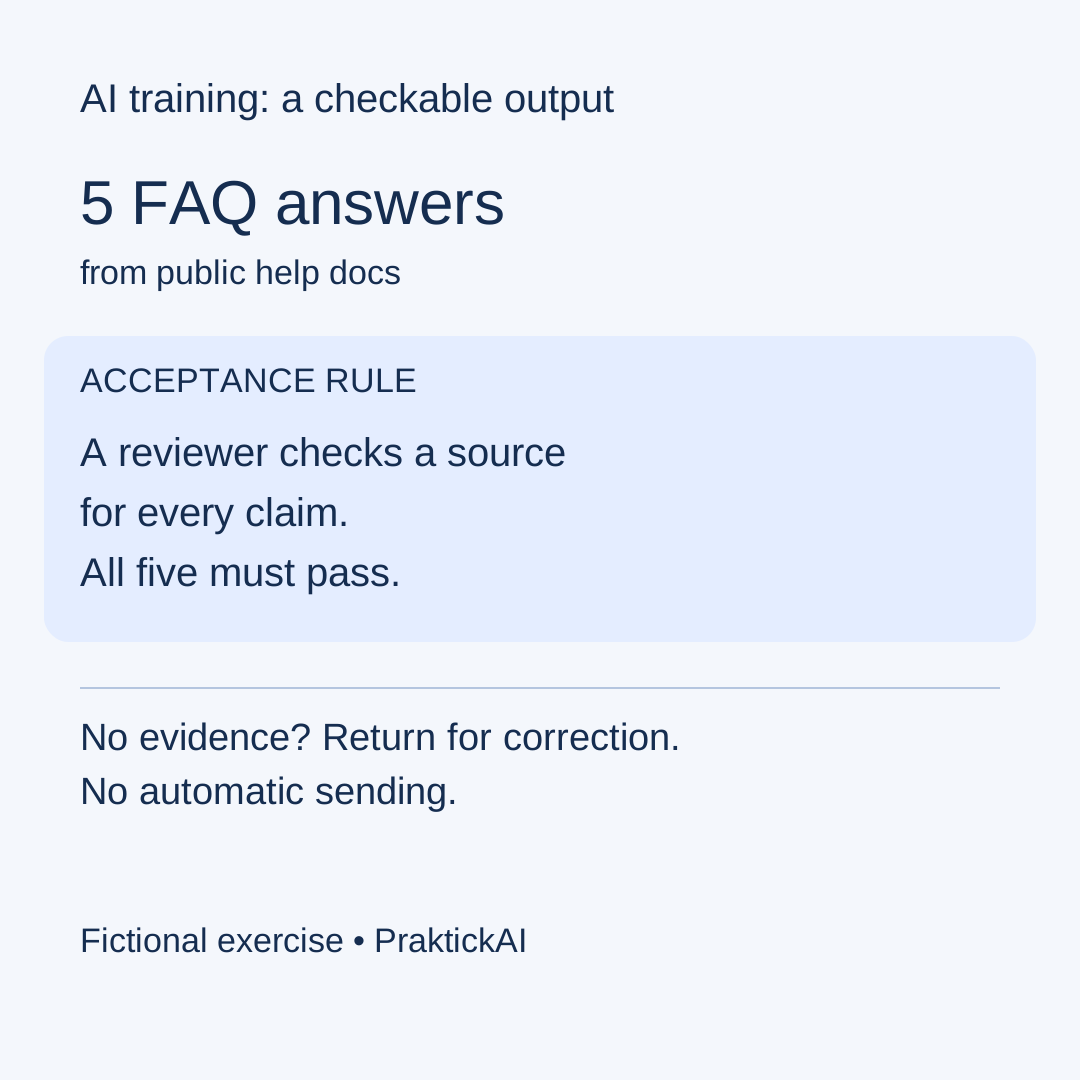
| Acceptance and human review | Eva accepts all five only after confirming that every claim matches its source and preserves its conditions. Return unsupported answers for correction. Five fluent texts alone do not pass. |
| Action boundary | Drafts remain inside the exercise. No automatic replies, publication or account changes. Accepting an exercise does not authorize sending an answer to a customer. |
| Measurement | One exercise within five working days; the same five questions and source version. Record preparation time, review time, returned drafts and accepted answers. No results exist yet. |
| Stop condition | Stop the exercise if an input is non-public. If a source is missing or contradictory, stop that answer and hand the question to Jana; do not guess. |
| Handover | Petr submits the five-answer table, source passages, review notes and measurement log. Jana decides whether to revise, repeat or end the exercise. |
2. The sentence that makes an answer pass or fail
Invented help documentation, version 1, “Export” section: “Choose Export in Settings. Export is available on the Pro plan.” Question: “Can I export on the free plan?” This is an authored illustration of review, not actual model output.
| Draft answer | Evidence and decision |
|---|---|
| “Yes, export is free for everyone.” | Reject. The source specifies Pro; it does not support the claim about the free plan. |
| “The help documentation lists export on Pro. This passage does not establish availability on the free plan.” | Accept for the exercise after checking the passage. The answer separates supported information from an unknown. |
When the source cannot support an answer, identifying the gap and handing it to a person can be the correct output. Include an example the team must reject in your training brief. Otherwise, a convincing sentence can be mistaken for competent work.
3. What the Academy actually announces
Anthropic’s announcement commits $100 million and targets 10,000 trained engineers by the end of 2027; these are not graduate totals. Organizations nominate participants with named projects. The announcement does not establish training effectiveness.
The program page describes experienced software engineers with LLM experience, four in-person days with assessment, then a 12-week organizational residency. Organizations ask their account or partner team about eligibility. This is not open beginner enrollment.
Our practical interpretation for a smaller team: name one output and its review method before comparing course outlines. The FAQ exercise does not replace an enterprise residency. It does give you a concrete question to ask a training provider: will the team be able to complete this task, including rejecting an unsupported answer?
4. Adapt the brief to one workflow
Choose an internal task you can practise using public or fictional inputs. Write its acceptance rule before its prompt. If you cannot name the source or reviewer, narrow the task. Before using real documents, check both your rights to the material and permission to use it in your chosen tool.
TASK AND ALLOWED INPUTS: ...
MANUAL BASELINE AND MEASUREMENT: ...
OWNER / AUTHOR / REVIEWER: ...
OUTPUT AND EVIDENCE FOR EACH CLAIM: ...
ACCEPTANCE RULE: ...
WHAT THE REVIEWER MUST REJECT: ...
ACTION BOUNDARY (what is not sent/published): ...
MEASUREMENT WINDOW AND METRICS: ...
STOP CONDITION AND HANDOVER CONTACT: ...
HANDOVER PACKAGE AND NEXT DECISION: ...
Copy the worksheet above or open the text version. Fill in one task and one sentence defining acceptance. Compare it with the official Academy description. You can also save the acceptance-rule card alongside your brief.

Karel Čech
Developer and AI consultant. I help technical teams adopt AI in their daily workflow — from workshops to long-term strategies.
LinkedIn →Stay ahead with AI insights
Practical tips on AI for dev teams. No spam, unsubscribe anytime.
Related posts
You're measuring AI ROI wrong: the metrics that actually show team impact
Leadership asks 'is the AI subscription worth it?' and reaches for lines of code or number of prompts. Those are vanity metrics. Here's what to measure instead.
Context engineering: the skill that replaced prompt engineering
Stop tuning prompt wording. In 2026 the bottleneck isn't how cleverly you phrase it — it's the context you feed the AI. This is the new core skill.
15 Claude Code tips I recommend to every dev team
From 50+ tips floating around the internet, I picked 15 that actually change how you work. These are the ones I recommend at every training — all tested on real projects.